


The scarcity mindset is something that I have observed in many people, including myself, and it was silently costing me more than I thought.
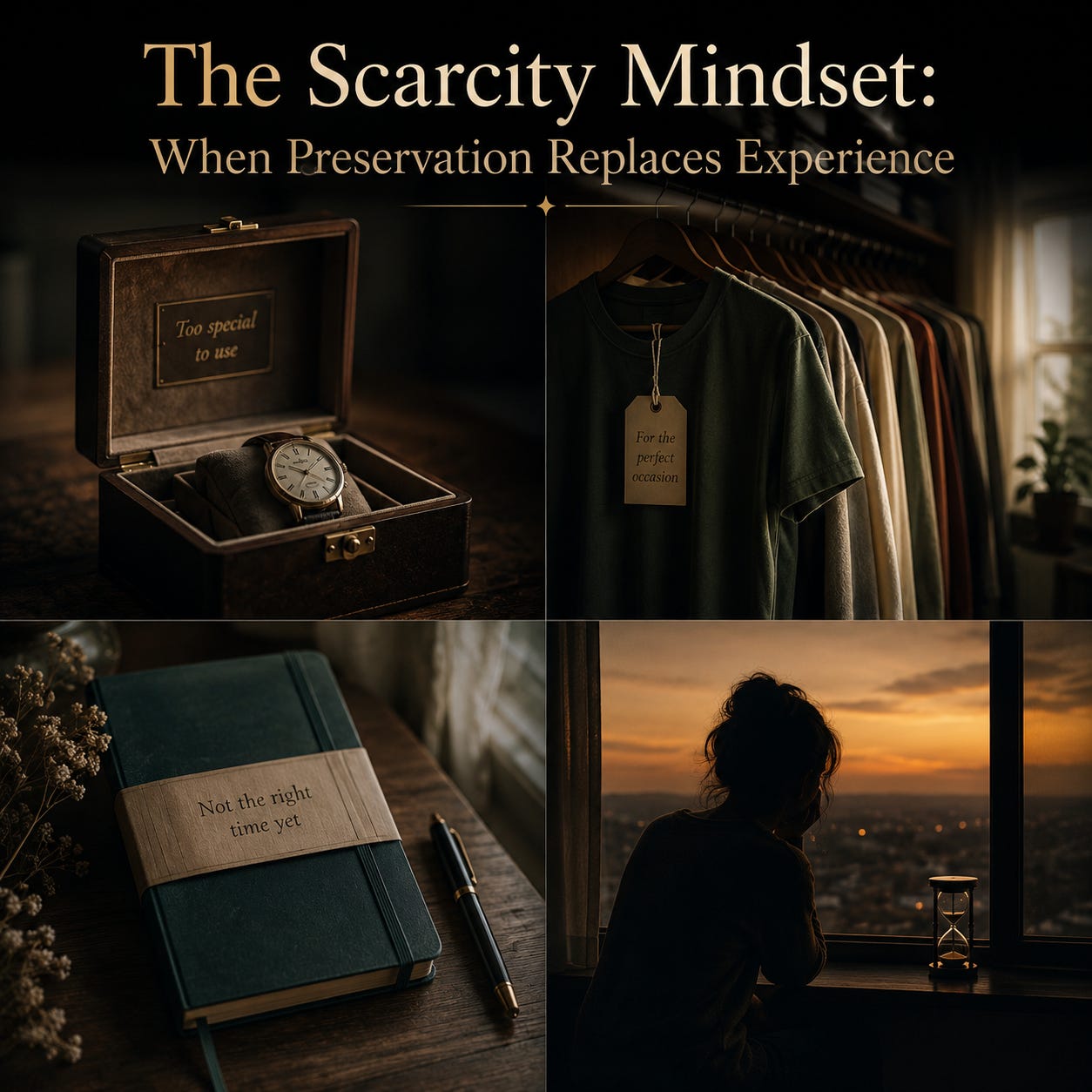
Whether it was a new T-shirt I bought, a beautiful diary I purchased to write "perfect" pieces, or simply anything else that became my most cherished possession.
Instead of experiencing it fully, I started preserving it.
Preserving it for the perfect moment.
For the perfect insight.
For the perfect time of consumption.
Slowly, without realizing it, I was preserving it more than experiencing it.
I started going deeper into this topic and realized why this happens.
1. Scarcity Mindset
Our brain behaves as though the things we love are impossible to replace.
This makes every use feel like spending a limited resource.
Instead of enjoying it, we start feeling guilty.
2. Loss Aversion
The pain of losing something feels greater than the pleasure of gaining something equivalent.
3. Endowment Effect
Once something becomes "ours," especially if we value it highly, its psychological value outweighs its objective value.
4. Delayed Gratification Taken to an Extreme
Delayed gratification usually helps in many situations, but when taken to an extreme, we tend to miss out on experiences in order to preserve them for the "right moment."
Thus, we end up protecting the experience instead of living it.
A healthier balance is created when we ask ourselves:
"Did I buy this to preserve it, or to enjoy it?"
For someone with a scarcity mindset, the mind often asks:
How do I make it last?
How do I avoid losing it?
Although these questions are important, when they replace the joy of experiencing the thing, person, or activity itself, they begin to diminish its value.
This is also triggered by an underlying thought process of Irreplaceability bias, where our brain subtly concludes:
"I won't find something or someone like this again."
or
"This is the best it will get."
Though this does help us value the object, person, or place a little more, when taken to an extreme, it squeezes the joy out of experiencing it while it lasts.
This brings me to the impermanent nature of everything.
In Buddhism
In Buddhism, this is called attachment (upādāna).
Attachment creates clinging to everything and dims the joy of loving and experiencing it in the present moment.
In Vedanta
In Vedanta, we might ask:
Who is this "I" that feels incomplete and attached to these things, and says:
"Without this, I become less."
In the Bhagavad Gita
Krishna repeatedly teaches Arjuna not to avoid love or action, but to avoid clinging.
That somewhat translates to:
"Use what comes to you with gratitude, but do not bind your peace to its staying forever."
In Zen
We might understand it as:
The purpose of flowers is to bloom.
The purpose of music is to be heard.
The purpose of a book is to be read.
Trying to preserve them to an extreme is to deny them their purpose.
True love doesn't imprison what it values; it allows it to fulfill its nature.
And thus arises a paradox:
"The more tightly we hold onto everything, the less of it we actually experience."
The scarcity mindset doesn't just limit our experiences,it reshapes them.
The more we fuel it, the less we find available to us.
As it focuses more on the impermanent nature of things, instead of enjoying the things, activities, and people we love while we still have access to them.
In the End
Instead of focusing on preserving the already impermanent aspects of life, we might want to remind ourselves:
"This may not last forever. Precisely for that reason, we should experience it fully rather than waiting for the perfect moment."
The purpose of the things we love is not to remain untouched. Their purpose is to be lived.
Thank you for spending a small part of your time here.
If you’d ever like to quietly support this journey and explore deeper creations like Awakening the inner eye and The Art of questioning, you can do so here.

The scarcity mindset is a quiet thief I’ve carried for years, slipping into my habits so gently I mistook it for caution. A new t‑shirt, a fresh journal, a small comfort I finally allowed myself — I almost always tucked it away, saving it for some imagined “right” moment. As if joy were fragile. As if goodness needed protection from me. I didn’t see it then, but I was loving things by hiding them. Guarding the experience instead of entering it. Holding blessings like contraband.
It’s strange how the heart can fear abundance. How it whispers that what is beautiful will never come again, so we clutch it tight, starving ourselves in the name of preservation. But anything held too tightly loses its purpose. A pen is meant to write. A page is meant to be marked. A gift is meant to be used, not embalmed.
Everything here is temporary — maybe that’s the mercy of it. Maybe the fleetingness is what teaches us to open our hands. To trust that what is given is meant to be spent, not stored. That beauty is not a museum piece but a daily bread.
Today, I’m trying to remind myself that waiting for the perfect moment is just another way of refusing to live. That the things I love are meant to fulfill their purpose while they are still in my care. That nothing good is strengthened by fear. And maybe — quietly, humbly — that there is a Giver who knows how to refill empty hands.